
ibuychemikalsCustomer Care
+91-90439 52109
For Enquiry
+91-73388 51002
Mon - Sat(10.00am to 06.00pm)
India's Most Preferred Online Chemical Storehttps://www.ibuychemikals.com/s/69c973fbd0520f3f14fd87f0/69d4fdf041876c4fcf6bc0b9/logo-ibuy-480x480.png
AB Block, Shanthi Colony, Anna Nagar, Chennai600040chennaiIN
ibuychemikalshttps://www.ibuychemikals.com
AB Block, Shanthi Colony, Anna Nagar, Chennaichennai, IN
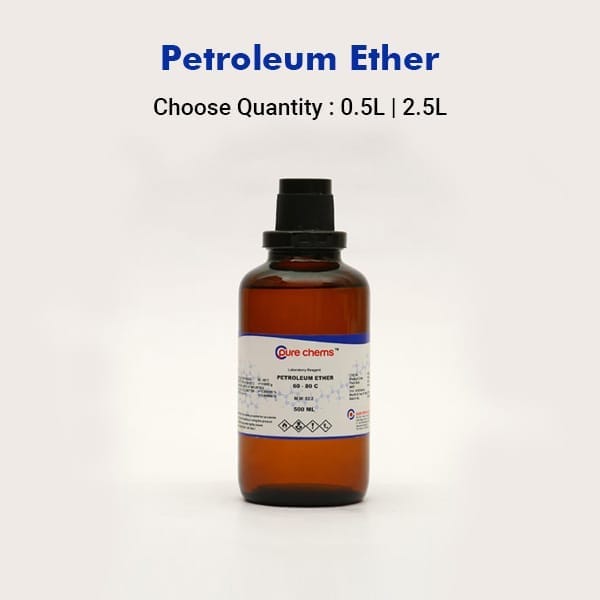
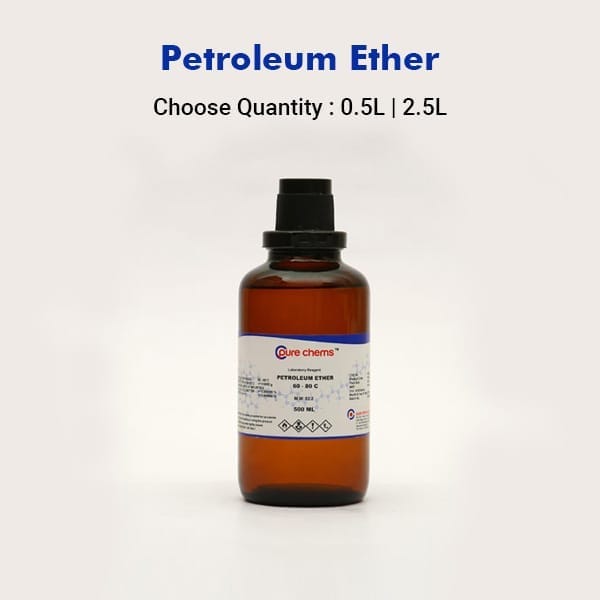
69f5e6563237d24d93054dd0Petroleum Ether 60C-80C LR
Petroleum Ether 60–80°C LR(CAS 8032-32-4) is a clear, colourless, highly volatile and flammable light hydrocarbon solvent with a boiling range of 60–80°C. Despite its name, it contains no ether functional group — it is a narrow-cut petroleum distillate consisting primarily of C₅–C₇ aliphatic hydrocarbons (pentanes, hexanes, and methylpentane isomers). The 60–80 suffix describes its boiling range in degrees Celsius, which determines its composition, volatility, and ideal application window.
It is the most widely usednonpolar solventfor laboratory solvent extraction, thin-layer chromatography (TLC), column chromatography, and degreasing in India. Known also as petroleum spirit 60/80, benzine, ligroin, or light naphtha, it is available from ibuychemikals in LR (Laboratory Reagent) grade — meeting standard purity requirements for research, pharmaceutical, and industrial use.
Please provide your delivery pincode to see products available in your area
Bestseller
Petroleum Ether 60C-80C LR
Brand/Manufacturer : Pure chems
CAS.No: 8032-32-4
What is a CAS Registry Number?
A CAS Registry Number is a unique identification number assigned to every chemical substance by the Chemical Abstracts Service (CAS). It helps scientists, suppliers, and buyers accurately identify a chemical, even if it has multiple names.
SKU: P002-31_0.5_Ltr
Sold By: Pure Chemicals Co
KYC Required
Why is KYC required?
KYC (Know Your Customer) verification is mandatory to ensure the safe and compliant sale of chemicals. It helps us verify buyer identity, prevent misuse, and comply with legal and safety regulations. Learn more.
**Delivery timelines may vary due to public holidays, special handling requirements for certain chemicals, or the need for road transport to ensure safe delivery. Learn more.
In laboratory solvent extraction, Petroleum Ether 60–80°C is the go-to nonpolar solvent for isolating lipids, oils, fats, waxes, and greases from solid or aqueous matrices. Its immiscibility with water allows clean phase separation, and its fast evaporation rate means extracts can be recovered by simple rotary evaporation or open-air evaporation without heat.
In chromatography, it is routinely used as the nonpolar component of TLC and column mobile phases — either alone or blended with ethyl acetate — to separate nonpolar compounds. For pesticide residue analysis and environmental GC-MS work (soil, water, sediment), the 60–80°C cut's narrow boiling range and low n-hexane content make it preferable to broader-cut solvents.
Petroleum Ether 60–80°C LR(CAS 8032-32-4) is a clear, colourless, highly volatile and flammable light hydrocarbon solvent with a boiling range of 60–80°C. Despite its name, it contains no ether functional group — it is a narrow-cut petroleum distillate consisting primarily of C₅–C₇ aliphatic hydrocarbons (pentanes, hexanes, and methylpentane isomers). The 60–80 suffix describes its boiling range in degrees Celsius, which determines its composition, volatility, and ideal application window.
It is the most widely usednonpolar solventfor laboratory solvent extraction, thin-layer chromatography (TLC), column chromatography, and degreasing in India. Known also as petroleum spirit 60/80, benzine, ligroin, or light naphtha, it is available from ibuychemikals in LR (Laboratory Reagent) grade — meeting standard purity requirements for research, pharmaceutical, and industrial use.
#
Attribute
Value
1.
Product Name
Petroleum Ether 60–80°C LR
2.
CAS Number
8032-32-4
3.
Boiling Range
60 – 80 °C
4.
Grade
LR
5.
Appearance
Clear, colourless liquid
6.
Density (20 °C)
~0.67 g/mL
7.
Flash Point
< −20 °C
8.
Composition
C₅–C₇ aliphatic hydrocarbons
9.
Solubility in Water
Insoluble (floats)
10.
Non-volatile residue
0.002% w/v
11.
Odour
Gasoline-like
12.
brand
Pure chems
1. What does 60–80°C mean in Petroleum Ether?
The numbers refer to the boiling range in degrees Celsius. Petroleum ether is not a single compound but a narrow-cut petroleum distillate fraction. The 60–80°C cut contains predominantly hexane isomers and is separated from lighter cuts (40–60°C) and heavier cuts (80–100°C) by fractional distillation.
2. Is Petroleum Ether the same as diethyl ether?
No - they are completely different chemicals. Petroleum ether is a hydrocarbon mixture with no ether functional group; it does not form peroxides and has entirely different hazard and chemical properties. Diethyl ether (CAS 60-29-7) is a single-molecule compound (C₂H₅)₂O that boils at 34.6°C and forms dangerous peroxides on storage. Always confirm which "ether" your SOP requires before ordering.
3. Why is Petroleum Ether used for extraction instead of water?
Petroleum ether is nonpolar - it selectively dissolves nonpolar compounds (oils, fats, waxes, lipids) that water cannot dissolve. Since it is completely immiscible with water, the two phases separate cleanly after shaking, allowing the nonpolar extract to be recovered simply by evaporation.
4. When should I use petroleum ether 60–80°C vs hexane?
Both are nonpolar solvents with similar polarity. Petroleum ether 60–80°C is a mixture that contains n-hexane along with methylpentane isomers and trace cyclohexane, making it slightly cheaper and often preferred for routine extraction. Pure n-hexane is used when a single-compound solvent is needed for regulated residual-solvent work (e.g., USP <467> / ICH Q3C pharmaceutical applications) where hexane content must be precisely quantified.
5. How should Petroleum Ether 60–80°C be stored safely?
Store in tightly sealed containers in a cool, dry, well-ventilated flammable-goods storage cabinet away from heat, sparks, open flames, and oxidising agents. Keep containers earthed during transfer. Avoid storing in low-lying areas where heavier-than-air vapour can accumulate. Maximum storage temperature: 30°C.